
Travellers are becoming increasingly conscious of their environmental and social impact. Recent reports have found sustainable travel remains important for 84 percent of travellers.
And this shift isn’t limited to leisure tourists, it’s increasingly shaping the behaviour of business travellers too. Reports show that embracing flexibility and sustainability within corporate travel so that it aligns with personal values will be key to attracting top talent, particularly among the Gen Z workforce.
However, the conversation has begun to move beyond sustainable tourism and toward something more ambitious – regenerative travel.
While sustainability focuses on limiting harm, regenerative travel aims to leave a place better than it was found. It combines travel with service, supporting local ecosystems, enriching communities and contributing to long-term cultural and environmental resilience.
Certainly, we’re seeing this play out on a global scale with the boom of ‘voluntourism’. And with the continued growth of bleisure, up 25 percent from 2024, regenerative travel is becoming increasingly intertwined with corporate mobility
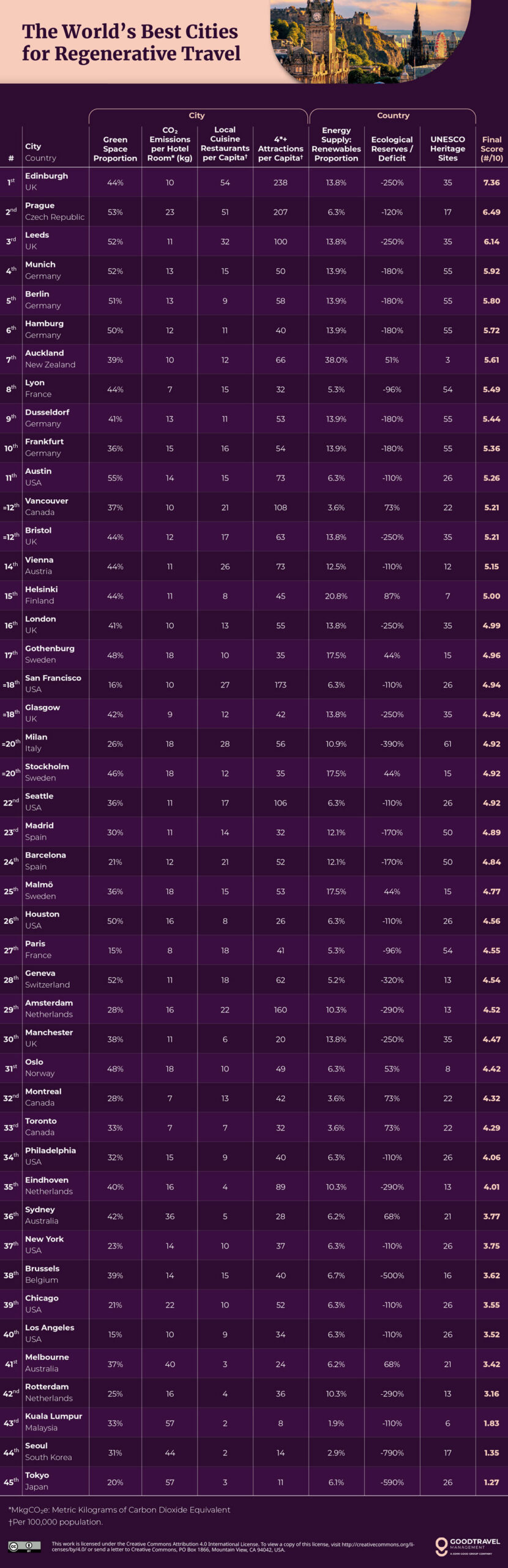
To understand where this ethos is taking root, we analysed some of the world’s leading cities to evaluate a range of indicators linked to regenerative potential.
This includes access to green space, carbon emissions associated with accommodation, cultural richness, support for local food systems, availability of high-quality attractions, national reliance on renewable energy, ecological reserves or deficits and UNESCO-recognised heritage.
1. Edinburgh, UK – Score: 7.4/10
Edinburgh tops the list as the world’s best city for regenerative travel, scoring 7.4 out of 10.
And it’s easy to see why.
The city performed well across all the metrics we looked at, but particularly for its proportion of independent eateries. With 54 local restaurants per 100,000 people, Edinburgh offers travellers plenty of chances to try authentic Scottish food, second only to Boston in our study.
Edinburgh’s hotels have impressively low emissions too, producing just 10.2 kilograms of CO₂ per room, making it one of the greenest cities in the world to stay in.
Edinburgh aims to be one of the best examples of low-carbon urban development in Europe. It has been investing heavily in urban regeneration, including a £1.3 billion redevelopment of the Granton Waterfront.
2. Prague, Czech Republic – Score: 6.5/10
In second place is Prague, Czech Republic, with a score of 6.5 out of 10.
Known for its gothic architecture and vibrant nightlife, the city also has plenty of green space, with 53 percent of its area dedicated to parks and open areas.
Visitors can explore more than 200 cultural attractions and 51 local restaurants per 100,000 people, many of which are included in the Prague Visitor Pass with unlimited public transport.
Prague is also shifting towards more sustainable tourism. The ‘Enjoy Respect Prague’ campaign introduced quiet hours and a ban on drinking in conservation areas, while the new ‘My Prague’ app helps visitors explore the city responsibly.
3. Leeds, UK – Score: 6.1/10
Leeds performs strongly across the metrics analysed, with 52 percent green space and relatively low hotel CO₂ emissions at 11 kilograms per room.
The West Yorkshire city also offers 100 high-quality attractions per 100,000 people and a prominent independent restaurant scene.
Leeds is growing rapidly while prioritising sustainability. The city was recently named Green Council of the Year, recognising ambitious environmental initiatives, and hotels like The Queen Hotel have earned Green Key Accreditation for their eco-friendly operations.
4. Munich, Germany – Score: 5.9/10
Munich, Germany, takes fourth place, with a score of 5.8 out of 10. It is one of four German cities to be ranked among the top 10.
As the home of Oktoberfest, the city has long held a strong cultural base for travellers. It welcomed 6.5 million visitors during 2025’s Oktoberfest.
But Munich is also one of the greenest urban destinations in the world, with 52 percent of the city being made up of green spaces.
5. Berlin, Germany – Score: 5.8/10
Germany’s capital just missed out on fourth place thanks to fewer local restaurants per capita, which Munich almost doubled.
However, progressive urban planning, abundant parks (51 percent green space) and world-renowned cultural scene position it strongly.
What does this mean for the future of business travel?
Responsible corporate travel doesn’t have to be complicated.
It can be as simple as choosing local restaurants, supporting local businesses, or even just spending time learning about the neighbourhoods and heritage of the city you’re visiting.
For businesses looking to make a bigger impact, find out how to measure, reduce and offset travel emissions for truly responsible sustainable business trips.
Methodology
To develop the study, we started by using Oxford Economics’ Global Cities Index (2025) to get a list of the world’s largest urban economies. We then gathered data around each location from the following sources:
- Green space proportion: https://www.husqvarnagroup.com/
- CO₂ emissions per occupied hotel room: https://hotelfootprints.org/
- Local cuisine restaurants & attractions: https://www.tripadvisor.co.uk/
- Country’s energy supply: Renewables Proportion: https://www.energyinst.org/
- Country’s ecological reserves/deficit: https://data.footprintnetwork.org/
- Country’s total UNESCO heritage sites: https://whc.unesco.org/
Once we had each city’s individual data points, we used minmax normalisation to give them a score out of 10 for each one. We then averaged those individual scores to get a final total for each location and ranked them accordingly.